|
Farriers' Greeting Cards - Hoofprints Website Navigator |
|
| Home | Closeouts | Kid's Stuff | Horse Owners | Dog Owners | Comments | Newsletter | Free Catalog | View Shopping Cart | | Greeting Cards | Sympathy | Art Prints | Gifts | Sportswear | Business | Envelopes | Stickers | Education | For Veterinarians | |
|
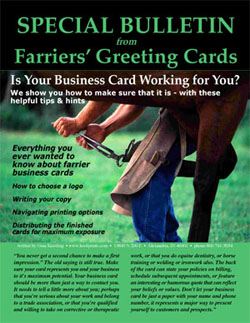
"You never get a second chance to make a first impression." The old saying is still true. Make sure your card represents you and your business to it's maximum potential. Your business card should be more than just a way to contact you. It needs to tell a little more about you; perhaps that you're serious about your work and belong to a trade association, or that you're qualified and willing to take on corrective or therapeutic work, or that you do equine dentistry, or horse training or welding or ironwork also. The back of the card can state your policies on billing, schedule subsequent appointments, or feature an interesting or humorous quote that can reflect your beliefs or values. Don't let your business card be just a paper with your name and phone number, it represents a major way to present yourself to customers and prospects.
1. Choose a design or logo Your logos should be appropriate for the type of work that you do. Farriers' Greeting Cards offers a selection of full color business card designs geared specifically for farriers. Or, you may wish to develop a logo that is unique to you. Many print shops offer this service, or you may already know someone who is involved in graphics that could design a custom logo for you. 2. Make a list of information Think about and decide what you want to include on the card. 3. Choose the most important information This should be shown in the largest, boldest print. In most instances this should include your name and business phone number. Less important information should be smaller to avoid crowding and confusion about what to read first. It is often helpful to use italic printing for the wording that describes your type of work (see #5) It is usually not a good idea to use more than one font (lettering style). 4. Other contact information Think carefully about the address and phone number(s). Some farriers find it necessary to allow clients to contact them at home, others prefer not to offer that option. Same with the address; if you do a lot of billing and mail correspondence, then it is probably necessary to show the address. If you prefer to keep that info private, or if you foresee an address change, then it should be omitted. Email - many farriers and their clients find this to be a useful (and non-invasive) method of correspondence. If you check your email regularly & don't intend to change email addresses, it should be on your business card as a way to reach you. 5. Include a brief description of you or your type of work This is something that you want clients to associate with you. Some examples are: Be aware that you will be held to the standard that you set for yourself. Stating that you do corrective or therapeutic shoeing invites that type of work, and may also get you referrals from veterinarians. If you are new to the business, stating your education or degree of certification is a good place to start. If you choose to put prompt or reliable, be prepared to act in that manner. 6. Optional back print Many farriers use this area to write the next appointment. If you have policies regarding scheduling, payment etc, you may want to include them on your card. The back is also a good place for a humorous or uplifting quote or verse. Be sure and give the author credit. If you don't know the author, put author unknown - not doing so implies that you wrote it. 7. Choose paper Your printer will need to know the kind of paper and ink colors that you want to use on your card. If you are having an artist design a logo, he or she may have specific recommendations. Prices will vary for different grades and weights of paper. Your printer will have samples so that you can compare them. Farriers' Greeting Cards uses a 10 point C1S (coated one side) cover stock. Coated means that a slick finish is applied to the paper; this gives the ink a richer appearance and makes full color printing look it's best. Paper with matte or textured finish can give a nice look to one or two color business cards. 8. Choose ink color(s) Printers use a universal ink mixing/color matching system, and they will have a book or chart of colors for you to look at. There is normally an extra charge for mixing a color that is not considered "stock" for that particular printer. A good starting point is to choose black (stock - no mixing charge) and a secondary color to accent the logo or add a bit of interest. 9. Decide a quantity Think about how you will be using your cards. Do you leave stacks of them at tack stores and stables? Do you use them to write the customer's next appointment or other notes on? The cost per card decreases dramatically as the quantity ordered increases - 2,000 cards may only cost 30% more than 1,000 cards. This is because the printer has significant time invested in job setup before the first card is ever printed. Get as many as your budget allows, but remember that they will not do you any good sitting in a box in your desk drawer! Plan ahead to make them available to your customers and prospects each time you see them. 10. Some notes about printing costs. Extras cost more. Just like adding clips and trailers and pads to a regular shoeing job increases the cost to the customer, so does adding extras to a printing job. Many printers have their pricing structured as follows: Basic card to include black ink on economy grade card stock $____.___ Upgrade to better quality card stock +$____.___ Add additional colored ink to print +$____.___ Ink mixing/matching charge +$____.___ Extra charge for logo or picture +$____.___ Something else to think about: Adding extra colors and using fancy paper will not improve your image if your card is badly designed. A poorly done logo, amateur looking typesetting and badly worded copy will negate all of the extras that you add. (We've all seen the person at the horse show with the most expensive tack and clothes that couldn't ride worth a lick!) "Some of the nicest cards I've ever seen consisted of a classy logo printed in one ink color on modest card stock.", says Gina Keesling, owner of Farriers' Greeting Cards. What made these cards stand out were the attention to detail in the logo, layout and typography. (Kind of like a nice looking foot with a neat row of clinches!) Farriers' Greeting cards keeps their color business cards in stock, ready to add the customer's information in black ink. This represents a significant savings of time and money for the farrier wanting full color business cards. They do the typesetting and layout at no charge and submit a proof for customer approval before printing. Article written by Gina Keesling, owner of Farriers' Greeting Cards. - A bit of background on our business cards: We printed and sold Greeting Cards for several years before I began doing color business cards. The very first card was done as a surprise for my husband Rob; I did a little painting of the hind leg of a gaited horse for the logo. Rob shod a lot of Saddlebreds, Morgans, Hackneys and Arab show horses, and really enjoyed the challenge of getting these horses to move their best. His customers really appreciated his attention to detail, and when he finished a job the horses went well and the feet looked beautiful. So a nicely shod hind foot with leather pad, clips, trailers and neat clinches was the perfect card for him. The cards were a big success, his clients loved them and there was no question as to the type of shoeing that he did! Now we offer over a dozen different business card designs for all kinds of shoeing and shoers. Sidebar: What to do with your business cards once you get them: Stick them on the bulletin board at your: Make them available at: Use them to schedule existing customer's next appointments, that way they will always have your card handy in case someone asks for a referral. Farriers' Greeting Cards sells a special magnetic calendar that you can affix your business card to. Make sure that your farrier friends have your card, too. They may be able to refer you to potential clients that are outside of their service area. |
|
© Gina Keesling - Farriers' Greeting Cards - www.HoofPrints.com 13849 N 200 E, Alexandria, IN 46001 - 765-724-7004 - gina@hoofprints.com |
Return to Farriers' Greeting Cards/Hoofprints - Articles